
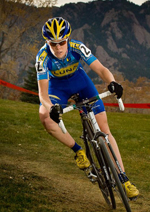
Mid-Season Cyclocross Self-Exam
by Ben Ollett
It's hard to believe, but we're already halfway through cyclocross season. Temperatures are dropping, the leaves are turning, and hopefully your race legs are still turning too. At a certain point in every person's 'cross season, there comes a period of "forced reflection." It usually doesn't come when things have been going great, but rather during an unplanned downturn.
This could be caused by sickness, or a string of sub-par races, or any number of life factors that may present themselves. Reflection, whether forced or not, is a great thing and you should embrace the opportunity.

Pull Through the Holidays without Putting on the Pounds
by Abby Cunningham
It's that time again. Mom's home cooking, parties galore, and sugar plum ferries dancing in your head. The holiday eating season is hard to resist. But with a few tricks up your sleeve, you can still enjoy your favorite treats and stay lean for the season ahead.
Here are six easy tips to help get you through the holidays:
1) Eat a post-ride meal, 2) Snack sensibly, 3) Enjoy what you love, 4) Pass the gravy, 5) Be the designated driver, 6) Go easy.

Bike Fitting Q & A: Saddle Selection
by Dario Fredrick
Q. I'm trying to buy a new saddle, but I just can't seem to find the right fit. Either it's too soft, too hard, too narrow or it just doesn't feel right. I love my old saddle, but it's time for a new one. Any suggestions?
A. This is a very common question...the quest for the perfect saddle. Your saddle is one of your three main contact points on the bicycle and arguably the most important. Together with foot orientation, it defines your pedaling biomechanics, efficiency and power output. More>
Pre-Race Mental Preparation
by Marv Zauderer
You're on the start line of your event – a race, a century, maybe that group ride that keeps kicking your butt. You've been working hard on your physical fitness, and you know your body's capable of what you're going to ask of it today. But what about your mind? Is it at its best, or in the way? By the time an event begins, the mentally fit cyclist has consciously created the state of mind that maximizes the likelihood of peak performance.

Sports Massage Holiday Specials at the Whole Athlete Performance Center
Book a massage for yourself and receive 50% off a gift certificate.
Packages:
Five 60 minute massages = $325
Five 90 minute massages = $450
Holistic Performance Newsletter - Vol. 22, Fall 2011
Mid-Season Cyclocross Self-Exam
by Ben Ollett
It's hard to believe, but we're already halfway through cyclocross season. Temperatures are dropping, the leaves are turning, and hopefully your race legs are still turning too. At a certain point in every person's 'cross season, there comes a period of "forced reflection." It usually doesn't come when things have been going great, but rather during an unplanned downturn.
This could be caused by sickness, or a string of sub-par races, or any number of life factors that may present themselves. Reflection, whether forced or not, is a great thing and you should embrace the opportunity.
Way back in August, you loaded up the race calendar with every single cyclocross race on the schedule. And your plan was to win every single race. I like your style – you're full of motivation and ambition. How has it worked out? I would guess that it probably hasn't gone exactly to plan. One reason for that might be that cyclocross is far more demanding than many give it credit for. Think of a cx race as a 40k time trial. What if you did two 40k TTs per week for 2-3 months? You'd quit bike racing, probably after a month. So, the key is to figure out what works for you – how often can you race and still maintain that edge to be performing at or near your best at every race? Below I've listed some ideas to consider as you approach the second half of the season. So, dig out the objective lens and take some time for a look back at the first half of the season. Keep an eye out for patterns!
Write down your best 2-3 races this year and your worst 2-3 races.
- Look back at the 1-2 weeks prior to those races. Consider:
- Training modes and intensity/frequency (Z3, Z4, Z5 work? Running? Skill work?)
- Number of rest days iii. Hours of sleep / sleep patterns
- Stress levels
- Travel schedule / timing
- The goal here is to see what left you firing on all cylinders for your good races, and what factors may have contributed to bad races.
- What types of races have gone well/poorly? Consider:
- How are your bike handling skills? Where do you excel and what holds you back? The goal here is to not to figure out that you should only do fast, dry courses with wide, sweeping turns, but rather to start working on your weaknesses. You want to have the same level of confidence going into a mudfest as you do a dirt crit. Cyclocrossers have to be complete riders, so don't pigeon-hole yourself into a certain type.
- What goes on in your head during good and bad races?
- What does your internal dialogue (self-talk) look like on your very best and very worst days? Write down some examples.
- What are you telling yourself on courses you know you're good on? What about the bad ones?
- If you're getting negative when confronting areas of weakness or low-confidence, I can guarantee you won't improve at them. Being aware of your internal dialogue is the first step in improving it. If you recognize it as an area that needs work, bring it up with your coach and consider talking to a sport psychologist.
Now that you've taken a good hard look at yourself, it's time to put this list to good use. Talk to your coach about it. Problems may have arisen from the training plan, but there's an equally good chance that they're coming from elsewhere. Sleep, stress, and everything else that life throws at you have a significant effect on your recovery, which in turn affects your training and racing. So, be honest with yourself, and talk to your coach about whatever's on your mind!
Pull Through the Holidays without Putting on the Pounds
by Abby Cunningham
It's that time again. Mom's home cooking, parties galore, and sugar plum ferries dancing in your head. The holiday eating season is hard to resist. But with a few tricks up your sleeve, you can still enjoy your favorite treats and stay lean for the season ahead.
1. Eat a post-ride meal.
After you do the Turkey Day ride, or the 75-mile holiday celebration loop, eat a light lunch, even if you're having a big meal soon after. Have a chicken sandwich on whole-grain bread, or make a wrap with a whole grain, gluten-free tortilla. Add a small side salad with mixed lettuces. Or, have a small portion of that yummy stir-fry you made the night before. Remember that it's important to refuel within 45 minutes of a longer ride. And never underestimate the calorie expenditure of riding in the cold. The last thing you want to do is bonk an hour before dinner with those bacon-wrapped figs sitting on the hors d'oeuvres table.
2. Snack sensibly.
If you're at a party with a massive spread, scan the buffet table for healthy noshes like fruits and veggies. Scale back on the nuts, cheeses, holiday cookies, and other high-fat, high-calorie foods, and walk away when you need to. Save the calories for your main meal.
3. Enjoy what you love.
Now that you're ready to sit down to dinner, give yourself a deprivation holiday. When you see something yummy cross the dinner table, don't fight it, give in! Just go easy, and enjoy it in moderation. Skip the foods you don't really love, and cut back on the ones you could eat any day. The exception of course, is veggies…eat them with reckless abandon, unless they're lathered in oil or sauce.
4. Pass the gravy.
OK, so maybe you love gravy, and you're thinking you'd rather follow tip #3, "Enjoy what you love." Instead of ladling extra fat on your meat and potatoes, see if you can just pass it on to the next person. If you're a gravy-aholic, try drizzling a little on for flavor. Remember that instead of the gravy you could have an extra slice of turkey, which has more protein to help rebuild those sore muscles.
5. Be the designated driver.
Alcohol is nothing but empty calories. One gram of alcohol has seven calories, which means that one medium-bodied beer with 5.6% alcohol has around 175 calories. As the designated driver, you can save your drinking allowance for that one really awesome glass of wine, or a small festive cocktail that you almost never have. Or you can skip alcohol altogether and drink mineral water or club soda. Steer clear of the tonic water, however. It has about 90 calories per glass.
6. Go easy.
Go easy on yourself. Don't expect to make huge gains in your diet/weight loss/chocolate austerity program during this time. Most weight loss for athletes occurs in the spring build periods when the training hours ramp up. Don't sweat it if you gain a couple pounds during the festivities.
Bike Fitting Q & A: Saddle Selection
by Dario Fredrick
Q. I'm trying to buy a new saddle, but I just can't seem to find the right fit. Either it's too soft, too hard, too narrow or it just doesn't feel right. I love my old saddle, but it's time for a new one. Any suggestions?
A. This is a very common question...the quest for the perfect saddle. Your saddle is one of your three main contact points on the bicycle and arguably the most important. Together with foot orientation, it defines your pedaling biomechanics, efficiency and power output.
A saddle should support both the width and contact angle of your sit bones (AKA ischial tuberosity). Width is the obvious one, but the lateral shape of the saddle ranges from flat to very rounded. The width and lateral shape should feel like they provide a stable platform for your pelvis. Then comes the length, rate of narrowing of the nose and lengthwise shape. Some saddles narrow down more than others, while some are flat, some "saddle" shaped and some have channels and cutouts. When in your common cycling position on the saddle with pelvis tilted forward, the majority of your weight should be borne by the sit bones. Ultimately, shape rather than softness defines whether a saddle is right for you or not.
One thing I often tell people is that if you find the perfect one, buy two. When one wears out, the other can serve as your replacement as you begin to explore other makes and models if needed. Keep in mind also that as a saddle begins to break in, its compression often results in the need to raise it slightly to compensate.
A common mistake that people make is setting up a new saddle in exactly the same position as the old saddle. Assume that saddle height, tilt and setback are all specific to a given saddle make and model. Although your existing height and setback measurements are a good place to start, you may have to adjust each to provide the correct position for optimal pedaling. As you know, saddles can vary in length, width, overall shape, and amount of compression. This will affect how you sit on the bike, even if you replace your old saddle with the exact same one, but a newer version. New saddles almost always have more loft than their retired twins, and you may wish to lower your saddle by ~2mm to compensate.
The only way to truly evaluate whether a saddle will work for you is to first make sure it is in the optimal position relative to pedaling. Much like with test-riding bikes, without being properly fit, you can't really make a fair evaluation. A saddle that is misplaced can be truly uncomfortable, even if it's ultimately the right saddle for you. We offer a multitude of saddle variations to try out, and the first step is making sure the saddle you want to try is set up properly. Come see us for a "saddle fitting" to help find the right one for you.
For more tips on saddle selection, check out the article By the Seat of Your Shorts.