
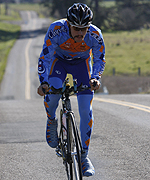
Cycling knees in winter
It's the time of year when many cyclists' knees begin to protest the combination of increased mileage and cold temperatures. Some may take the knees for granted, but many experience knee pain at one time or another when cycling, especially in winter. Understanding the knee joint and its role in pedaling can help. Preventative maintenance such as good biomechanics and proper use and care is important, and what you do off the bike can make a difference as well.
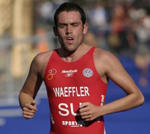
Meet new multisport coach, Reto Waeffler
Whole Athlete is proud to welcome to our coaching staff professional triathlete and multisport coach, Reto Waeffler. Reto brings more than 20 years of athletic experience and excellence to the Whole Athlete multisport division as a former 3-time All-American Collegiate triathlete and multiple junior national champion.
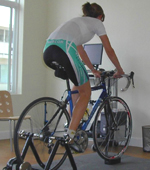
Indoor training
Although our winter in Northern California has been remarkably dry, there are always times when cyclists are forced to train indoors. Sometimes you just can't bear another wet ride, have run out of daylight, or realize that inclement conditions make it just too dangerous to train outdoors. So how do you move your training plan off the roads and into your living room? With proper attention to three areas - environment, workout components, and motivation - cyclists can get their training done without heading outside.
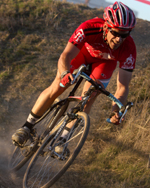
Athlete spotlight: Brian Staby
Brian Staby (Team NorCal Bike Sport) has trained with Whole Athlete for three seasons. After finding some success in criteriums (1st place, 2007 Cloterium) and stage races (2nd place GC, 2007 Madera Stage Race,) he turned his hand to the mayhem in the mud that is cyclocross. This is his first full season racing ‘cross, and he made it count, winning the Bay Area Super Prestige series in the Masters B's. Brian took some time away from his day job as a Santa Rosa fireman to share some thoughts on ‘cross and why he likes it.
Mental training: Recovering from crashes
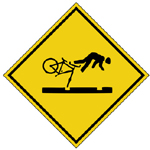
Crashes – being in them, seeing them, hearing about them – are a part of life for us cyclists. In addition to any physical healing that needs to happen, there are things you can do to accelerate the mental side of your recovery. The quicker you recover mentally, the quicker you'll be back out there performing at your best.
By Dario Fredrick
It's the time of year when many cyclists' knees begin to protest the combination of increased mileage and cold temperatures. Some may take the knees for granted, but many experience knee pain at one time or another when cycling, especially in winter. Understanding the knee joint and its role in pedaling can help. Preventative maintenance such as good biomechanics and proper use and care is important, and what you do off the bike can make a difference as well.
Know your knee
The knee joint is fundamental in producing pedaling power on the bike. The torque applied through the downward segment of the pedal stroke is the highest area of force production, accomplished through a combination of hip and knee extension. The extension of the knee is a result of contracting the quadriceps muscles in the front of the thigh, which cross the front of the knee joint and pull against the lower leg. The quads straighten the leg at the knee, a hinge joint. Since the quadriceps make up the largest muscle group (especially in cyclists!) the knee joint deals with much of the workload in cycling.
While many tend to associate the illio-tibial (IT) band with the knee, it is not directly involved in movement of the joint. The IT band is a long, broad tendon that originates above the hip at the illium bone (hence “illio”), runs along the side of the outermost quadriceps muscle (vastus lateralis), and crosses the lower, front of the knee, attaching to the larger of the two lower leg bones (tibia = “tibial”).
The IT band actually begins as two muscles, the gluteus maximus and the tensor fascie latae (TFL) at the hip. The glut max is a hip extensor, a primary muscle involved in downward torque in the pedal stroke. The TFL is an abductor, so while its main job is to take the leg away from the midline to the side, in cycling it works more to stabilize the leg as the hip flexes and extends.
Knee problems
Knee pain is one of the most common problems cyclists experience, typically a result of various degrees of tendonitis: inflammation or strain of the tissue that connects the quadriceps across the knee to the lower leg, or friction along the outer knee from illio-tibial band tension. Although many people refer to IT band tightness as the cause of their knee problems, technically it's the muscles that develop tightness initially, rather than the tendon itself. If the glut max is tight, it can pull the IT band. Since the IT band runs along the outer quad like a sheath, if the muscle develops knots or tension, these areas can inhibit movement of the IT band. IT tension can result in friction where it passes across the side of the knee, creating an internal “blister” called a bursa.
Lateral misalignment of the knee joint can also result in tendonitis from pedaling when the muscles on one side become overworked. When the knees are valgus (bowed inward when standing), or the outer quads are extremely tight, the mid and inner quadriceps (rectus femoris & vastus medialis, A.K.A. VMO) can become challenged and fatigued, straining its tendon attachment. The result is pain along the inner border and/or the lower front of the kneecap (patella). This situation is often coupled with resulting IT band tension. Less common, although equally challenging is pain in the back of the knee - usually a result of hamstring tendonitis where the muscles that flex the knee become overworked and their lower attachments strain.
Solutions
Many tendon problems can be avoided or reduced by deeply relaxing and smoothing out the muscle from which the tendon originates, or in the case of the IT, also the muscle along which it runs (lateral quadriceps). Chronically tight or knotted muscles can increase tension at the attachment, thus overloading the tendon. Avoid stretching a muscle with an inflamed tendon, as it often places additional strain on the weak or injured tendon attachment. Instead, massage the belly of the muscle itself to help release it. Professional deep tissue sports massage can do wonders for overworked or knotted cycling muscles, while acupuncture can be extremely effective at healing damaged tissue as well.
Knees are no exception to the chestnut of ‘prevention being the best medicine'. First and foremost, proper biomechanics are fundamental to minimizing risk of injury. As a professional bike fitter and long time cyclist myself, I cannot stress highly enough the importance of optimal bike positioning for the knees. This includes cleat alignment in addition to proper saddle position. Once you have an optimal fit, how you pedal determines the load at the knees as well. Try to pedal in a more horizontal rather than vertical, downward manner at times to develop the weaker areas of the pedal stroke. Avoid overgearing, especially when climbing. For the same relative power, climbing vs. flat terrain tends to require higher force, as we are limited by gearing and working against gravity. We know that the most efficient range of cadence when climbing is ~70-90 rpm, depending on the workload. Have low enough gears on your bike to pedal at a minimum of 70 rpm on most climbs and at a moderate level of intensity.
Keep your knees warm. Since tendons do not receive direct blood supply like muscle tissue, the body cannot regulate their temperature as well. Like most elastic tissue, when it is colder, it loses elasticity, becoming more vulnerable to tearing at higher force. A pre-ride knee prep I have found effective in the winter includes massaging arnica oil into the knees and wearing leg or knee warmers. The oil serves as both a barrier to the cold, as well as a lubricating, anti-inflammatory agent, and the warmers keep both muscles and joints warm.
The bee's knees
Be kind to your knees - they're the only ones you've got. Keep your cycling muscles long and relaxed off the bike, and be sure that your fit and pedaling mechanics are the best you can create. Keep your knees warm on the bike, and spin light enough gears to become supple in your pedal stroke and strong in your legs. Your knees will thank you in the long run.
New multisport coach, Reto Waeffler
Whole Athlete is proud to welcome to our coaching staff professional triathlete and multisport coach, Reto Waeffler. Reto brings more than 20 years of athletic experience and excellence to the Whole Athlete multisport division as a former 3-time All-American Collegiate triathlete, ITU World Cup athlete, and multiple junior national champion in Modern Pentathlon.
Originally from Schaffhausen, Switzerland, Reto excelled in Modern Pentathlon in the early to mid 90s, then transitioned into triathlon when shortly after, he earned three All-American Collegiate titles while completing a degree in business management at Cal Poly. Reto earned a spot on the Swiss National Triathlon Team in both 2003 & 2004, and became a professional world cup triathlete. Notable recent results include winning the Bear Valley Triathlon in August 2008 and finishing a strong 2nd place at the Marin County Triathlon in October. He also recently completed his MBA at Santa Clara University and currently acts as the head coach of the Stanford University Triathlon Team.
Trainer
Time
By Peter Nicholson
Although our winter in Northern California has been remarkably dry, there are always times when cyclists are forced to train indoors. Sometimes you just can't bear another wet ride, have run out of daylight, or realize that inclement conditions make it just too dangerous to train outdoors. So how do you move your training plan off the roads and into your living room? With proper attention to three areas - environment, workout components, and motivation - cyclists can get their training done without heading outside.
The chief limiter of performance indoors is heat, so perhaps the most important piece of equipment is a proper fan. Chances are whatever you have laying around the house will not be sufficient – I recommend the Vornado, which, despite its cheesy name and not-insignificant price, is a serious fan with a small footprint. You'll also want to have a decent trainer with sufficient resistance, like the CycleOps Fluid 2 or SuperMagneto, or set of rollers, such as Kreitler Challenger. If you can train in a garage or basement where there is limited heat, excellent, otherwise open some windows and turn off the heat. Pay particular attention to staying hydrated, as even with the best cooling there will be significant sweating. Of course, you'll also need a towel – and perhaps some sort of air freshener if you don't live alone.
When attempting to modify a prescribed outdoor workout to be performed indoors, examine the focus of the workout. Typically, this is the interval portion of the workout and what you should attempt to complete. Use the lower intensity (<= Zone 1) Endurance Ride portion of the workout to warm up, for recovery between intervals, and to cool down, but don't attempt to replicate the same amount of ride time indoors as outdoors. The lower intensity is where you can cut down on total workout volume to a manageable amount. Trainer time tends to be more concentrated work than outdoors, so reducing total workout time doesn't mean you have to sacrifice quality.
Some workouts just can't be done inside (climbing workouts, full-on sprint workouts) but you can address some similar physiological areas, e.g. turning ten minute climbing repeats into ten minute Tempo Endurance repeats at the same prescribed intensity or performing eight seated max accelerations instead of eight out of the saddle sprints. Keep in mind that heart rates will be typically be higher/ experience more cardiac drift due to the generally higher temperatures indoors and less cooling effect than moving at speed through the outside air. Even if you only have an endurance ride planned with no intervals scheduled, providing some structure goes a long way toward making the time pass more quickly. Try doing some cadence-focused work or single leg pedaling exercises, both of which take on an added dimension when performed on rollers.
The final component of effective indoor training is motivation. Without the environmental stimuli typical of outdoor riding (varying terrain, the satisfaction of covering distance, traffic, other riders) time tends to stretch out interminably when on the trainer. But listening to a favorite mix or album on headphones or watching videos of races go a long way toward making the time pass. I even have one athlete who swears by re-runs of South Park, although I personally have a hard time imagining guffawing at Kenny getting killed once again and being able to complete a zone 3 interval. The key is to find something that will keep your mind off the clock.
The next time you're forced to train indoors, get your equipment sorted, your workout adjusted, and a good album cued up on the headphones. Then take advantage of the opportunity to complete a solid chunk of quality training. After all, there's no coasting on a trainer.
Athlete
Spotlight
By Peter Nicholson
Brian Staby (Team NorCal Bike Sport) has trained with Whole Athlete for three seasons. After finding some success in criteriums (1st place, 2007 Cloterium) and stage races (2nd place GC, 2007 Madera Stage Race,) he turned his hand to the mayhem in the mud that is cyclocross. This is his first full season racing ‘cross, and he made it count, winning the Bay Area Super Prestige series in the Masters B's. Brian took some time away from his day job as a Santa Rosa fireman to share some thoughts on ‘cross and why he likes it.
What was your athletic background?
I grew up playing soccer for the most part and only rode a bike to get around town and cause trouble. Novato was not an exciting place for kids...probably still like that. I went to college at UC Santa Cruz and "walked-on" my junior year there. They are Division III, so no scholarships, which was nice because everybody was playing because they really loved the game. Go Slugs!
There were lots of trails around Santa Cruz so I rode my mountain bike a lot. My first job in the fire service was in Merced. Not much to do there so I got a road bike. Shortly after moving to Santa Rosa I got involved in the Tuesday night crit series here. The rest is history... I was hooked.
What was your first bike race and how did it go?
I don't really recall my first bike race, but it was probably a Tuesday night crit, first race, which is essentially 4's and 5's. I got dropped and lapped. But I was happy because I didn't give up. My one hour "training rides" weren't helping me that much.
When did you start racing cyclocross and what did you like about it?
I started dabbling in ‘cross 3 years ago. I knew nothing about it. Never took a clinic or class - talked to a few people who had done it and just figured it out from there. It was a big learning curve and I am still working on my form, especially mounts/dismounts. I think I did maybe 3 races the first year. Then was ready to go the second year and I had surgery mid-season, so that kind of messed up the rest of the season for me. This year was my first full year of cross.
Has your coach John Hunt helped you train for ‘cross specifically?
Oh yeah. We did quite a big road calendar and then he had me scale it back in August. 2009 will be fully dedicated to cross. I get on the cross bike at least once a week, not including races. I made these collapsible barriers out of PVC piping that I can take in a backpack to a park or up in Annadel. It must look weird...some guy jumping over PVC with a bike. Oh well...I don't care.
Tell us about some training that you felt helped you in races this season?
Intervals, intervals, and some intervals in between. A cross race is one big interval. So 30 seconds at 200 watts and 30 seconds at MSS (maximal steady state) for 5 minutes = my tongue is dragging...and then repeat. Short climbing intervals help also. Then, in the early season I got quite a bit of running in. Helpful - especially when you are carrying a bike on your shoulder.
What is your favorite thing about cyclocross?
It is intense and then it is over with. My body tends to do well at events like those –time trials, crits, cross. Road races...not so much. I also like the feel of a cross race - a little more laid back, not as intense as the road thing. And how about that weather? Again, I do better when it is cold and rainy. I wilt in the heat.
How do you feel this ‘cross season workout out for you?
I had always wanted to well in the Bay Area Super Prestige (BASP) series. I just loved the venues and the promoters do a great job at putting this series together. So I entered in the Master's B's. After I won the first race at McClaren Park by over a minute I was "called out" by other riders...”sandbagger!” I felt a little bad about crushing those guys, but I got over it. I had already started the series and wanted to finish it. I finished it alright and won all the races and the overall series. It was pretty awesome because they have a leader's jersey and I got to wear it throughout the series. On to the Master's A's. I am taking my licks with these guys, but learning a lot along the way.
How do you think cyclocross skills translate to the road?
Well the suffering is the same. The more you suffer, the better you will do. Cross helps with interval training, but it does not help with doing long road races. In cross you train for short races and that is not what most road races are all about. I can feel it when I go out on a long training ride of 3-4 hrs. Not used to that.
What are your goals for the 2009/10 CX season?
To win... :) No, I will probably be focusing on getting used to the increased pace with the Master's A's. I would like to do some traveling, in order to do some races I haven't done before. The US Grand Prix of Cyclocross expanded to 4 races next year, so that looks intriguing. But I will really focus on Nationals. It is in Bend, Oregon for the next 2 years, so that will be nice for travel. Might even be some snow...:)
Mental
Training: Recovering From Crashes, Part 1
(originally published in PezCycling News)
By Marvin Zauderer
Crashes – being in them, seeing them, hearing about them – are a part of life for us cyclists. In addition to any physical healing that needs to happen, there are things you can do to accelerate the mental side of your recovery. The quicker you recover mentally, the quicker you'll be back out there performing at your best.
In last month's Sport Psychology column, on Assessing Your Mental Fitness, I explained steps you can take during this off-season to evaluate and improve your mental skills. This month, we add to the Advanced Skills of the mentally fit cyclist covered in past installments of this column, and begin to explore how to recover – mentally – from crashes, in Part 1 of a two-part series.
It was May 20, 2007. Dr. Prentice Steffen, Garmin-Chipotle Team Physician and Medical Director, had just watched the peloton start a rainy stage 3 of the Tour of Picardie near Paris. Since the team was headed to Spain next for the Volta a Catalunya race, Dr. Steffen figured he'd get a headstart. He swung his car onto the autoroute and headed for Barcelona. Within minutes, he realized that he was in the worst possible spot: stuck behind the peloton, with no good alternate route. He pulled off the road, and decided to wait until the race cleared. He turned on his race radio. Suddenly, the news crackled through: Garmin-Chipotle rider Steven Cozza had crashed. Dr. Steffen sped to the scene, and found Steven face down, unconscious. Calling on his expertise in emergency medicine, Dr. Steffen stayed with Steven as he was loaded into the ambulance and taken to the hospital.
Steven had a bad head injury and serious neurological symptoms that persisted upon his return home: loss of memory, difficulty focusing, trouble perceiving hot and cold temperatures, an altered sense of taste, and problems with coordination and depth perception. He picks up the story:
"I wasn't sure how long the symptoms could last – maybe even years. With a head injury, you really don't know how long it will take to heal, or if it will. I was really depressed. One week, I was competing with the best athletes in the world and doing well at it, and then I went to not being able to get out of bed. I didn't know if I would ever be normal again.”
A head injury is bad enough. But research has also shown that the brain can change as a result of emotional trauma – experienced during and after the traumatic event – and depression is a common consequence.
For the complete article, please visit http://www.pezcyclingnews.com/?pg=fullstory&id=6502&status=True.